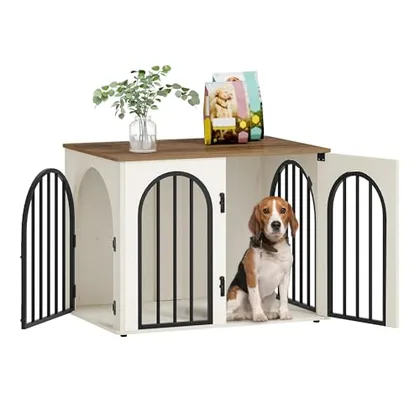
31.5'' Dog Crate Furniture
31.5" · engineered wood
$107.99
How to measure a dog, why an oversized crate backfires, and what breaks first on a furniture crate.
By the Hzuaneri workshop · published 28 August 2026 · updated 28 August 2026
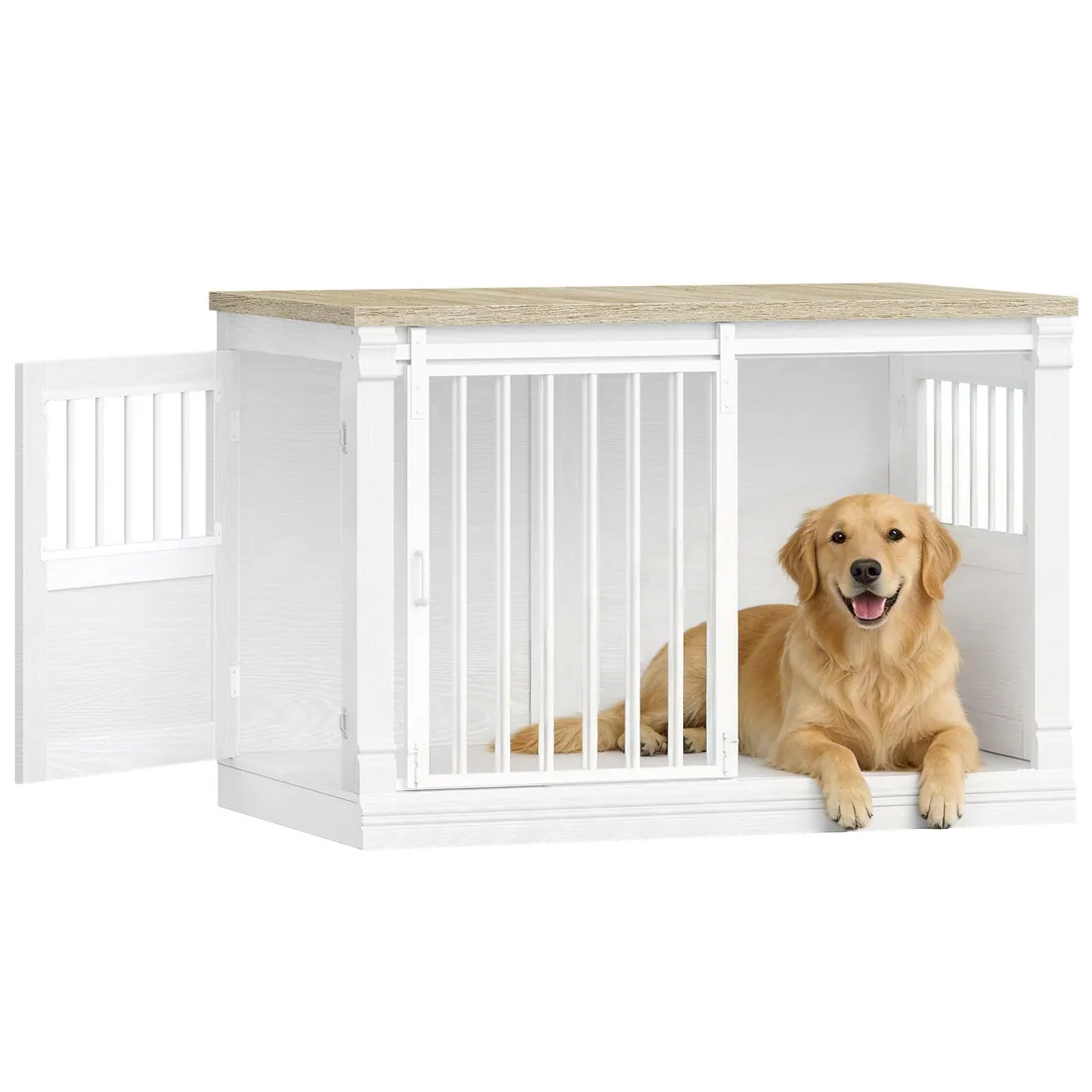
The crate is the one piece of dog gear that does not tuck into a closet. It sits where you sit, and it is roughly the size of a loveseat. For years the answer was a wire box with a plastic pan, and we all learned to look past it. That answer works. But when the living room is also the dining room and the office, a wire box in the corner starts to feel like a compromise you did not agree to.
A furniture crate flips the question. Instead of hiding the dog's space, you give it a surface that earns its square footage, a lamp table, a television stand, a place to set down a coffee cup. The dog gets the same den, and the room gets a piece of furniture that pulls its weight.
The Hzuaneri range includes forty-two crate cabinets, from a narrow end-table piece to a double-wide sideboard. The widths run from twenty-three to eighty-seven inches, and every one of them is built to hold a dog on the inside and a household on top. The top is flat and rated for weight, so a lamp, a television, or a plant sits there without a second thought.
This guide walks through sizing, safety, placement, and the moments when a furniture crate is the wrong call. The goal is not to sell you a cabinet. The goal is to help you land on the right crate for your dog and your room, whether it comes from our lineup or not.
Breed labels are a starting point and a poor one. Two Labrador mixes can differ by six inches in length and forty pounds in weight. The only measurement that matters is the dog in front of you, standing on your own floor.
You need three numbers. Length: nose to the base of the tail, measured along the spine while the dog stands square. Height at the ears: the dog sits, you measure from the floor to the top of the head or the ear tips, whichever is taller. Shoulder width: the dog stands, you measure across the widest point of the chest.
Add a hand's width to the length, about four inches for a medium dog, six for a large one. That is the minimum interior depth of the crate. Add three to four inches to the sitting height. That is the minimum interior height. The dog must be able to stand without ducking, turn a full circle without scraping a wall, and lie flat on its side with its legs stretched out.
A dog that cannot stretch out will shift all night. A dog that cannot stand straight will develop a hunched posture over time. Neither is a small thing.
A crate that fits right is a den. A crate that is too large becomes a bathroom with a bed at one end. Dogs avoid soiling their sleeping area, but only if the whole floor reads as sleeping area. Give a puppy a crate meant for an adult shepherd, and it will pee in the far corner and curl up at the door. House-training stalls, and the dog learns a habit that is hard to undo.
An undersized crate is worse. A dog that cannot turn around lives in a cage, not a den. The stress shows up as whining, chewing at the bars, and a reluctance to enter. Over time it erodes the crate as a place of rest.
The right crate fits the dog you have today. If you are buying for a puppy, you can block off part of the interior with a divider and open it up as the dog grows. Several of our wider cabinets include a divider for exactly this reason. Once the dog reaches adult size, you remove it and the cabinet fits for life.
31.5" · engineered wood
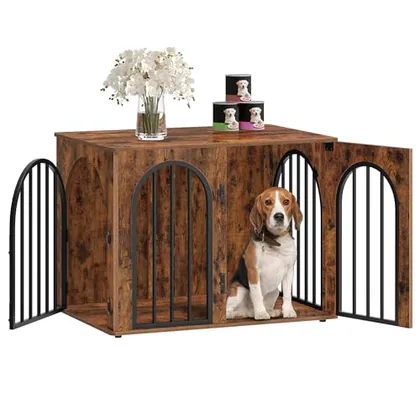
31.5" · engineered wood
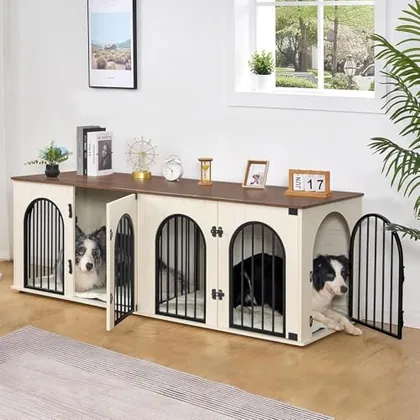
70.9" · steel
A crate with bars on only one side is a box with a window. The dog sees what is directly ahead and nothing else. That narrow view can make a nervous dog more nervous, a sound from the side has no visual source, so it is just a threat in the dark.
Two bar sides, ideally at a right angle, give the dog a wider picture of the room. A sound from the left comes with a glimpse of the cat walking past. A sound from behind is just you shifting in your chair. The dog settles faster because the world makes sense.
Airflow matters for the same reason it matters in a bedroom. A crate with bars on one end only traps warm air. In summer, in an apartment without cross-breeze, that turns the crate into a stuffy box the dog avoids. Two open sides let air move through. The dog sleeps cooler, and the crate smells less like dog by the end of the week.
All our crate cabinets open on at least two sides. The wider pieces, the ones that double as sideboards, open on three. The dog can see the room and the room can see the dog, and that turns out to matter for both parties.
A flat top rated for weight changes where the crate can live. A crate with a sloped or wire top goes in the corner because it cannot do anything else. A crate with a solid, level top goes against the wall behind the sofa and holds a lamp and a stack of books. It goes under the television. It goes next to the front door with a dish for keys.
Our crate cabinets are built with a top that is meant to be used. The surface is flat and finished, and the cabinet structure carries the load down to the floor. A lamp, a modest television, a row of plants, these are ordinary uses, not edge cases.
That does not mean the top is a shelf for anything heavy enough to tip. A crate cabinet is not bolted to the wall unless you bolt it, and a dog inside it is a living weight that shifts. Keep the top load under roughly forty pounds, keep it balanced, and do not stack things high enough that a tail wag could knock them off. Common sense, but worth saying.
| Width band | Pieces | Price from | What it suits |
|---|---|---|---|
| 23.4-31.9 in | 14 | $85.49 | A tight corner or a single animal |
| 31.9-44.1 in | 14 | see below | The common case: one room, one animal, room to turn |
| 44.1-86.6 in | 14 | $249.99 | Two animals, or a piece that doubles as a sideboard |
Widths measured across the 42 pieces in this department.
A dog that learns to open a crate is a dog that cannot be crated. The problem usually starts with a latch that is simple to nudge. A sliding bolt with no lock, a spring catch that a paw can depress, these are puzzles a bored border collie solves in an afternoon.
The lineup uses a two-point latch on the main door. The mechanism sits flush with the bar, so there is nothing for a paw to hook. The action is firm enough that a dog cannot bump it open, but a person can work it with one hand. That last part matters when you are holding a coffee cup in the other.
The floor is the other point of failure. A wire grate over a plastic pan catches claws. A gap between the floor panel and the wall traps a paw. A floor that sits directly on the ground wicks up cold from the floorboards. Our cabinets raise the interior floor slightly off the base, so air circulates underneath. The surface is smooth, with no gaps at the edges. A blanket goes on top, and the dog lies on a warm, flat plane.
A furniture crate lives with a dog, and a dog has teeth. The finish on the bars and the wood needs to survive a certain amount of mouthing, especially in the first weeks.
These pieces use a metal finish on the bars that resists rust and does not flake. The wood surfaces are sealed, not painted, so a scratch does not peel. The materials were chosen for a piece of furniture that holds a living animal, not a display cabinet that holds china.
That said, a determined chewer will damage any crate. A dog that gnaws the bars for hours is not a candidate for a furniture crate. The bars will hold, but the finish will not, and the dog may hurt its teeth. This is not a training guide, but the short version is: if your dog chews the crate, the problem is not the crate. Address the chewing before you invest in a piece of furniture.
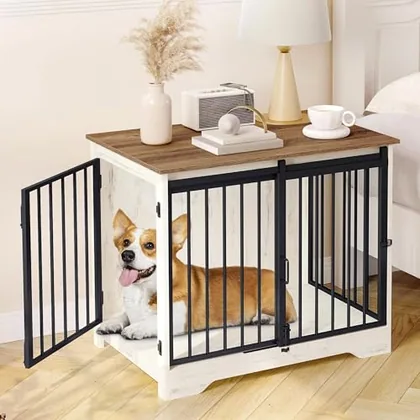
31.9" · steel
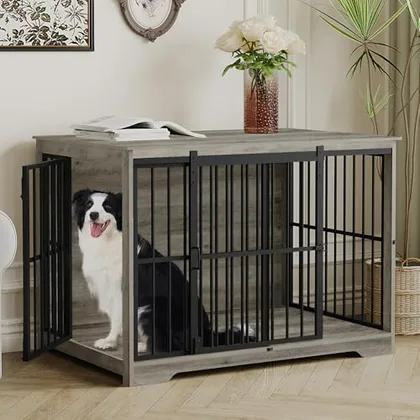
44.1" · engineered wood
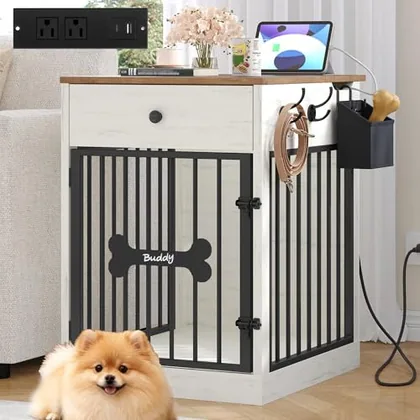
24.6" · metal
Placement is half of crate success. A crate in the middle of the room is exposed on all sides, and a dog that feels exposed will not rest. A crate in a walkway gets bumped by passing feet, and the dog startles every time.
The ideal spot has a wall behind it. The dog can see the room but knows its back is covered. Keep the crate away from radiators, heating vents, and direct sunlight through a south-facing window. A crate that heats up becomes a box the dog tolerates than seeks out.
Leave enough clearance to open the door fully. That sounds obvious until the crate is wedged between a sofa arm and a bookshelf and the door swings only halfway. The dog learns to squeeze through a gap, and one day it catches a hip.
Consider the human traffic pattern. The crate should not be the first thing you step around when you walk into the room, and it should not block the path to the door. A crate against the wall behind the sofa is out of the way. A crate next to the television stand is part of the room's furniture rhythm and does not interrupt flow.
A new crate is a new room in the house. The dog needs time to read it as safe. Dropping a dog into a closed crate on day one is the fastest way to create a negative association that lasts.
Day one, the door stays open. Put a familiar blanket inside. Drop a treat near the entrance. Let the dog investigate on its own. Do not coax, do not push. If the dog goes in, praise quietly and let it come back out. The goal is choice.
Day two, feed the dog near the crate, then just inside the open door. The bowl goes far enough in that the dog's body follows. Still no closed door.
Day three, close the door for five minutes while you sit nearby. The dog has a chew or a stuffed Kong. You are present, calm, not making eye contact. Open the door before the dog asks to be let out.
Day four and beyond, stretch the time slowly. Vary the duration so the dog does not learn that a closed door means a long absence. Five minutes, then two, then fifteen. Leave the room for short periods. Return without fanfare.
A dog that enters the crate on its own and lies down has accepted it as a den. That is the milestone. The time it takes varies by dog. A confident adult may settle in three days. A rescue with crate baggage may need two weeks. Let the dog set the pace.
A cabinet does not make a smell disappear. The tray, the litter and the day you last cleaned it do that. What furniture changes is whether the room has to look like a utility area.Hzuaneri workshop notes
A furniture crate solves a specific problem: the dog needs a crate, and the room needs the square footage back. It does not solve every crate problem, and it makes some worse.
A dog with separation anxiety should not be crated in any crate without a behavior plan. A furniture crate is a larger investment than a wire box, and a panicked dog can damage both the crate and itself. Work with a trainer or a veterinary behaviorist first. The crate comes later.
A puppy that still chews everything it can reach is a risk to the wood finish. The bars will hold, but the cabinet will look like it lived with a puppy. Wait until the chewing phase passes, then bring in the furniture piece.
A dog that has learned to escape wire crates may also escape a furniture crate. The latches are stronger, but an experienced escape artist finds weaknesses. A dog that has injured itself breaking out of a crate needs a different containment strategy, not a prettier box.
A dog that is too large for any crate in the range is simply too large. The measurements are the measurements. An eighty-seven-inch sideboard crate fits a Great Dane. A dog bigger than that needs a custom solution, and we do not make one.
A crate cabinet that matches the room's other pieces disappears in a way a wire crate cannot. The Hzuaneri range is designed to read as furniture first, clean lines, flat fronts, neutral finishes. They sit next to a sofa or under a window and do not announce themselves as dog gear.
The surface on top means you can build a small scene around the crate. A lamp, a stack of books, a trailing plant. The crate becomes a console table that happens to have a dog inside it. Guests do not notice until the dog stands up and wags.
The crate also anchors a corner of the room. A narrow piece between two chairs creates a defined sitting area. A wide piece under a wall-mounted television centers the wall and hides the cables. The dog's den becomes part of the room's structure, not an obstacle you arranged the furniture around.
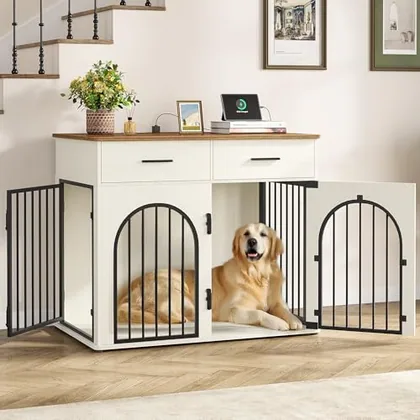
43.3" · metal
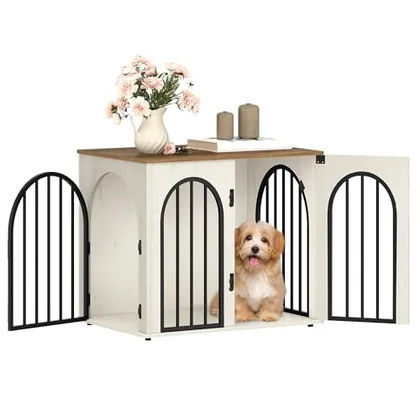
26.8" · engineered wood
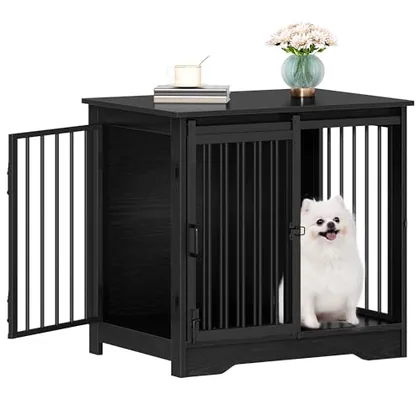
27.2" · engineered wood
A wire crate gets hosed down in the yard. A furniture crate cannot be hosed down, but it still needs to stay clean. The interior floor lifts out on most models. Wipe it down with a mild cleaner, let it dry, put it back. The bars wipe clean with a damp cloth. The wood surfaces clean like any wood furniture, a dry or slightly damp cloth, no harsh chemicals.
The blanket or pad inside does the heavy lifting. Wash it weekly. A dog that sleeps on a clean pad in a clean crate smells less like a dog, and the room smells less like a kennel. That is the whole secret.
A double crate holds two dogs that already share space peacefully. It is not a tool for introducing two dogs that do not get along. Two dogs in one crate need enough room to lie flat without touching if they want to. Measure each dog separately, add their lengths together, and add a hand's width between them. That is the minimum interior width.
Our double-wide cabinets start near sixty inches, which fits two medium dogs or one large dog with room to stretch. The divider that comes with some models can split the interior into two separate dens. Each dog gets its own entrance, its own space, and its own blanket. They can still see each other through the bars, but they are not forced to share a floor.
A furniture crate is a piece of furniture. It should last as long as a sideboard or a bookshelf. We build on that assumption, solid joinery, sealed finishes, hardware rated for daily use over years. A dog lives in it, but the cabinet does not read as a dog product. When the dog is no longer with you, the cabinet is still a cabinet. The bars can be removed on some models, and the interior becomes open storage.
That is the idea behind the whole category. The dog's needs come first, safety, airflow, fit. But the room's needs are not an afterthought. A crate that earns its place in the living room stays in the living room, and the dog stays with the family instead of being tucked away in a spare bedroom.
Measure your dog. Pick a spot with a wall behind it. Give the introduction the days it needs. The right crate, in the right place, with the right introduction, becomes the place your dog goes to rest on its own. That is the win.
